Beyond the Rough Ride
Everyone expects failing suspension to feel rough, so the genuinely useful signs are the seven that arrive before the ride quality collapses — because suspension wear is gradual enough that drivers recalibrate to it daily and notice nothing. The stakes are not comfort. Dampers exist to keep tires pressed against pavement; worn ones let the tire skip and float over every imperfection, and a tire in the air neither steers nor stops. Measured tests show cars with worn shocks needing meaningfully longer to stop on imperfect surfaces and breaking traction earlier in emergency swerves. The eight signs below are ordered roughly by how early they appear, and each carries its usual culprit and honest price, so the inspection happens while the fix is still a component and not a corner of the car.
1. Nose-Dive and Squat
Watch the hood under moderate braking: a healthy car settles slightly and holds; a car with worn front struts plunges nose-down, then rocks back as you release. The mirror image — tail squatting deeply under acceleration — indicts the rears. Both mean the dampers can no longer control weight transfer, which is precisely their emergency-stop job: a nose-diving car unloads its rear tires exactly when maximum braking needs all four planted. This sign typically appears months before ride quality degrades noticeably, making it the earliest cheap warning in the set. Culprit: struts or shocks, $500–$1,100 per pair installed.
2. The Bounce Test You Can Do Today
The oldest suspension test still works as a coarse screen: press your full weight down on one corner of the parked car, release at the bottom of the stroke, and count. One rebound that settles is healthy damping; two or more full oscillations mean that damper has retired from active duty. Test all four corners — wear is rarely symmetrical, and a single dead corner destabilizes the whole platform. The test's limits are honest: it catches badly worn dampers and misses moderately worn ones, so a passing bounce is not a clean bill, but a failing one is a booked inspection. Free, thirty seconds, and the reason to stop trusting “it feels fine” — your adaptation is the thing being tested.
3. Cupped and Scalloped Tires
Run a flat palm across each tire's tread. A rhythmic wave pattern — scooped dips repeating around the circumference, often with a growling road noise that mimics a bad wheel bearing — is cupping, and cupping has one dominant cause: dampers letting the tire hop against the pavement thousands of times per mile, each landing scrubbing a little rubber. This sign matters doubly because it compounds — the ruined tires must be replaced along with the dampers, or the vibration continues on fresh suspension. Catching cupping at the faint-pattern stage saves the tire set; catching it at the audible stage usually does not. The tire shop that shows you the wear pattern during a rotation is doing you a favor worth taking seriously, a dynamic our guide to choosing a repair shop covers under trust signals.
4. Wandering and Nervous Steering
A car that needs constant small corrections on a straight highway, follows pavement grooves, or feels vaguely late responding to inputs is describing worn control-arm bushings, tie-rod ends, or ball joints — the pivot points that hold your alignment steady under load. The wear lets wheel angles flex dynamically: aligned when parked, wandering in motion, which is why fresh alignments that do not cure the symptom point here. Loose steering components are also the failure family with the worst endgame — a separated ball joint drops the corner of the car — so persistent wander earns a same-month inspection. Culprits price individually at $150–$400 per joint installed, plus the alignment that any pivot replacement mandates.
5. Clunks Over Potholes
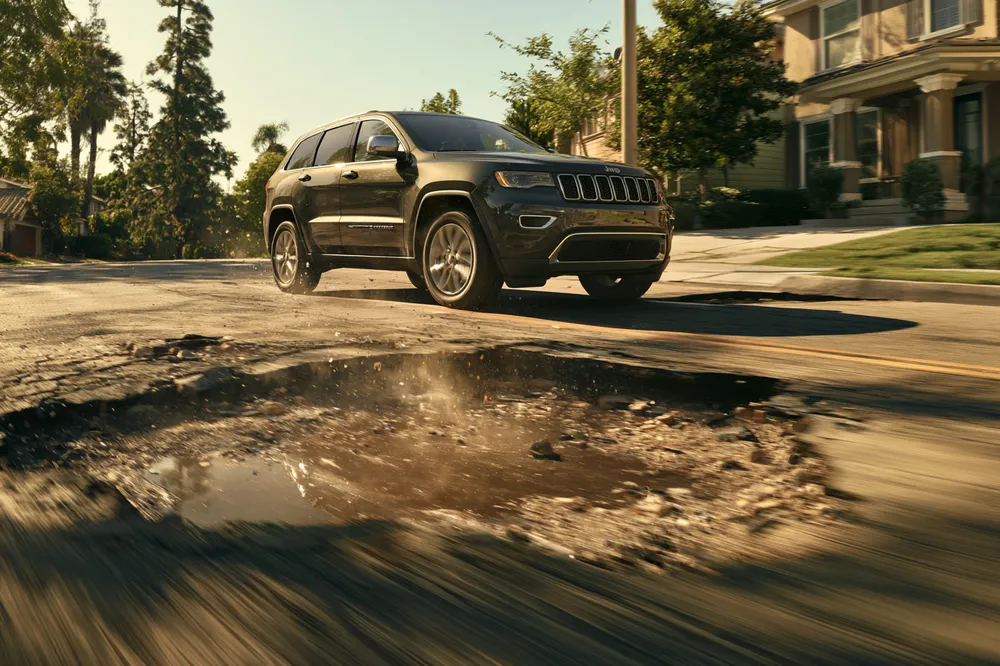
A single dull clunk from one corner over sharp bumps is the sound of clearance where none should exist: a worn strut mount, a torn sway-bar link, a control-arm bushing with play, or a damper losing its internal grip. Clunks are the most diagnosable noise in the suspension family because they localize — note the corner and the bump type, and a technician with a pry bar finds the loose joint in minutes. They are also the sign most worth acting on quickly relative to cost: sway-bar links run $100–$250, mounts $150–$350, and each is a small part protecting larger ones from impact loading they were never meant to absorb. A clunk ignored for a season has a habit of inviting friends.
6. Leaning in Corners and Crosswinds
Body roll that has quietly grown — the car heeling noticeably in ramps and swaying in truck wash on the interstate — reports that the springs and dampers no longer manage lateral weight transfer. Drivers rarely catch this one themselves precisely because it grows at adaptation speed; passengers notice first, and their comment is data. Excessive lean lengthens emergency-swerve recovery and unsettles the car mid-corner exactly when grip budgets are spent. Where sign one indicts damping on the braking axis, this one indicts it laterally, and the fix is the same strut-and-shock service — with the alignment after, non-negotiably, since damper replacement disturbs geometry.
7. Uneven Stance in the Driveway
Park on flat pavement and photograph the car head-on and from behind: one corner sitting visibly lower names a sagging or broken spring, worn spring seat, or collapsed mount. Springs break more often than drivers assume — corrosion plus potholes — and a broken coil sometimes announces itself only as a slight lean and a new creak. Ride height also sets the suspension's working geometry, so a low corner drags alignment and handling with it. Repair runs $300–$700 per corner for spring and seat work; loaded strut assemblies (spring, damper, and mount pre-built) frequently make sense here, trading higher parts cost for less labor and no spring-compressor risk, the bundling logic priced on our brake and suspension loans page.
8. The Mileage Clock Itself
The eighth sign is the odometer: dampers are wear items with a service life of roughly 60,000 to 100,000 miles depending on roads and loads, and a vehicle past that window with all-original suspension is presumptively due for inspection even if every other sign is quiet — adaptation, again, is the confounder. This matters most at used-car purchase: a 110,000-mile vehicle with original struts has a four-figure service hiding in its near future, worth naming in negotiation. Treat the interval like tires: not a failure, a schedule.
Cost Table and Bundling Logic
| Repair | Typical Installed Cost |
|---|---|
| Sway-bar links (pair) | $100 – $250 |
| Strut mounts (pair) | $150 – $350 |
| Individual ball joint / tie-rod end | $150 – $400 |
| Shocks or struts, per pair | $500 – $1,100 |
| Spring / seat, per corner | $300 – $700 |
| Full strut set with alignment | $1,000 – $2,200 |
Bundling is legitimate here more than almost anywhere in car repair: dampers replace in axle pairs, pivots disturb alignment, and labor overlaps heavily, so one combined visit prices below the sum of serial ones. The test for any bundle remains asking which lines are required versus convenient — and expecting the parts shown.
From Symptom to Sorted
The sequence: run the bounce test and stance photos today (free), book an inspection the week any sign persists, get the itemized estimate with the worn parts identified by name, and take the second quote when the number crosses four figures. Then decide the payment on a known total rather than a fear: suspension work clusters in the $1,000–$2,200 band where a fixed-payment personal loan turns an ambush into a scheduled monthly line — the mechanics are on the brake and suspension loans page, the monthly math one slider away in the calculator, and the budget-protection habits that make the next suspension cycle a non-event live in our emergency repair budget guide. The car has been telling you; the eight signs are just the translation.
Funding a Suspension Refresh Without the Sticker Shock
Suspension work produces this blog's classic sticker-shock estimate — the $1,400–$2,200 strut-set quote on a car that “drives fine” — and the funding plan has to answer both the size and the skepticism. The size first: bills in that band sit above most emergency funds and below most banks' interest, which is exactly the gap personal loans in the $500–$5,000 range exist to fill, on fixed 24–36 month schedules whose monthly figures (preview any quote in the calculator) land in the $60–$100 territory most working budgets can absorb. The skepticism second: the eight signs above are the evidence standard — finance measured wear (leaking dampers shown, bounce test failed, cupping visible), never adjectives, and take the second quote at anything over four figures before any road loan application goes in.
The bundling economics also favor the financed single visit. Dampers, mounts, and the mandatory alignment share labor heavily, so one combined appointment on one road loan prices meaningfully under the same work split across seasons — and the road lending network's next-business-day funding means the combined visit can be this week's, at the shop your audition process already vetted. One honest counterweight: on a vehicle near its end, a full suspension refresh can exceed the car's remaining value, and personal loans should never outlive the vehicle they repaired — the resale-value math in our resale guide is the tiebreaker for that call. When the car is a keeper, though, this is among the most satisfying financed repairs on the menu: road loans convert a four-figure ambush into a fixed line item, and the payoff arrives twice daily — once in the corners, once in the emergency stop you hopefully never need.
Bottom Line
Suspension hides its failure inside your daily adaptation, which is why the eight signs above outrank how the car feels. Run the free tests this week, trust measured wear over quoted adjectives, and bundle the work — dampers, mounts, alignment — into one evidence-based visit. Fund it the same way: personal loans sized to a second-quoted estimate, on terms the worst month survives, with road loans converting the classic four-figure ambush into a fixed line the calculator priced in advance. The keeper-car case rewards that personal loan twice daily in grip and stopping distance; the end-of-life-car case fails the resale math and deserves honesty instead of financing. Either way, the deciding evidence is free and sitting in your driveway — which makes this the rare four-figure decision that costs nothing to make correctly.
Reader question worth appending: should suspension be repaired before or after new tires? Dampers first, always — worn shocks cup fresh rubber within months, so tires installed onto tired suspension inherit the old problem at new-tire prices — money no personal loan should ever fund twice. When both are due, the combined visit remains the answer, and sizing a personal loan to the joint invoice beats two purchases in the wrong order — one personal loan, one alignment, one appointment. The exception proves the rule: tires at genuine safety minimums cannot wait for a suspension budget or a second personal loan, so a personal loan covering both together resolves the sequencing entirely — which is what road loans at the $2,000–$3,000 tier spend most of their working lives doing. A personal loan cannot decide the order, but a personal loan makes the right order affordable this week, and road loans funding next-day mean the sequencing question never becomes a waiting question. Order matters in suspension work; road loans exist so respecting it costs a payment, not a season.
Keep Reading

Squeaky Brakes Decoded
Every brake sound translated, with the calendar each one sets.
Brake & Suspension Loans
Financing struts, springs and alignment from $500 to $5,000.